Does Webflow compress images? Its resized copies are re-encoded, and Webflow says converting to WebP or AVIF is a button
On this page
In our sample Webflow didn't turn JPEG and PNG files into WebP or AVIF on its own, but it did re-encode the resized copies it makes. On 15 November 2026 we drew 379 sites at random from Webflow's Made in Webflow showcase, loaded their home pages in Chrome 157 and fetched the Webflow-hosted images that 306 of them loaded. For 300 of 300 image addresses the server sent byte-identical files whether Chrome said it takes AVIF, only WebP, or neither. Nearly all the JPEG copies were libjpeg quality 80, and nearly all the PNG copies were palettes of at most 256 colours. For AVIF files, the median WebP copy at 800 pixels and wider weighed more than the AVIF it came from.
One guide to Webflow image optimisation, dated 16 April 2026 on its page, says "Webflow automatically serves WebP versions when browsers support it, but the source images need to be optimized before upload". Webflow's own help says converting to WebP or AVIF is a Compress button in the Assets panel, and that responsive copies are made on upload. We checked the guide's sentence and the help's account of copies against the files.
Chrome got the same file whatever it asked for
We asked for 300 addresses (JPEG 104, PNG 90, WebP 77, AVIF 29) with three Accept lines, the header a browser uses to say which formats it takes. All 300 came back identical and none carried a Vary header, so the Accept line didn't change what the server sent. Some sites do choose from it. For those 300 files the guide's sentence is wrong. We asked the same question of Squarespace, Wix and Shopify in earlier posts.
Chrome fetched 2,644 raster files, 1,853 of them JPEG or PNG and 765 WebP or AVIF. Of the 270 sites with a raster image, 87 served at least one WebP or AVIF. A plain file is the file at an image's own address. Of the plain files whose asset was created from 1 August 2024, after AVIF upload arrived on 31 July, we found 123 JPEG and 132 PNG next to 150 WebP and 231 AVIF, so 255 files made since then are still JPEG or PNG. We didn't run the Compress button. Webflow's help describes it as lossy, and "the original asset files will be replaced".
Webflow's resized copies are re-encoded
Webflow does shrink its JPEG and PNG copies: the JPEG copies weighed a median 0.22 of their plain files and the PNG copies 0.26. Webflow's help calls them variants. Here a copy is a resized file with -p-500 to -p-3200 in its name. We asked for every copy name of the 1,095 plain raster files that pages showed in an image element and that are wider than 500 pixels, and found 1,780 copies. Each is as wide in pixels as its name says, and none is byte-identical to its plain file.
| Plain file | Copies | What a copy is | Median bytes against the plain file | Larger than it |
|---|---|---|---|---|
| JPEG | 418 from 127 files | 406 are libjpeg quality 80, 4:2:0, baseline; 12 from four August 2021 files differ | 0.22 | 0 |
| PNG | 488 from 191 files | 462 are palette PNGs (256 colours or fewer) | 0.26 | 0 |
| WebP | 567 from 213 files | lossy WebP | 0.36 | 11 |
| AVIF | 307 from 114 files | 231 lossy WebP, 76 AVIF | 0.95 for WebP, 0.46 for AVIF | 109 and 3 |
The 406 JPEG copies come from 123 files whose plain file reads anywhere from about quality 60 to 100, so a quality 99 file gets a quality 80 copy. We read that off the quantisation tables, so the finding is that the tables are libjpeg's quality 80, not which program wrote them. Transparency survived in 277 of the 280 PNG copies whose plain file has a non-opaque pixel. The other three were copies of one image whose plain file had no alpha below 254, and they came out fully opaque. No copy carries EXIF, a camera make or GPS coordinates.
Which images get copies
Webflow's help says background images, rich-text images and CSV or API imports get none, and that if "your original images are compressed enough, Webflow uses your original images". Of the 676 raster images that pages used as CSS backgrounds, 675 were plain files. None of the Webflow-hosted images we found sat in rich text, so that rule is untested.
Of the 1,095 plain files, 645 had at least one copy:
| Plain files | With a copy |
|---|---|
| Created up to 2016 | 4 of 212 |
| Created 2017 to 2023 | 189 of 342 |
| Created 2024 or later | 452 of 541 |
| On custom domains | 471 of 609 |
On webflow.io addresses |
174 of 486 |
Webflow's help says it measures images and makes copies "as you work on a site page", and that sites made before 14 September 2016 need a migration step to get them. Of the 450 files without a copy, 208 were made up to 2016, though a file's date isn't its site's. From outside we can't tell why any of the 450 lack one.
To check an image of yours, open the page source and look for -p- in its srcset, the list of sizes the page offers the browser.
An AVIF file can get heavier copies
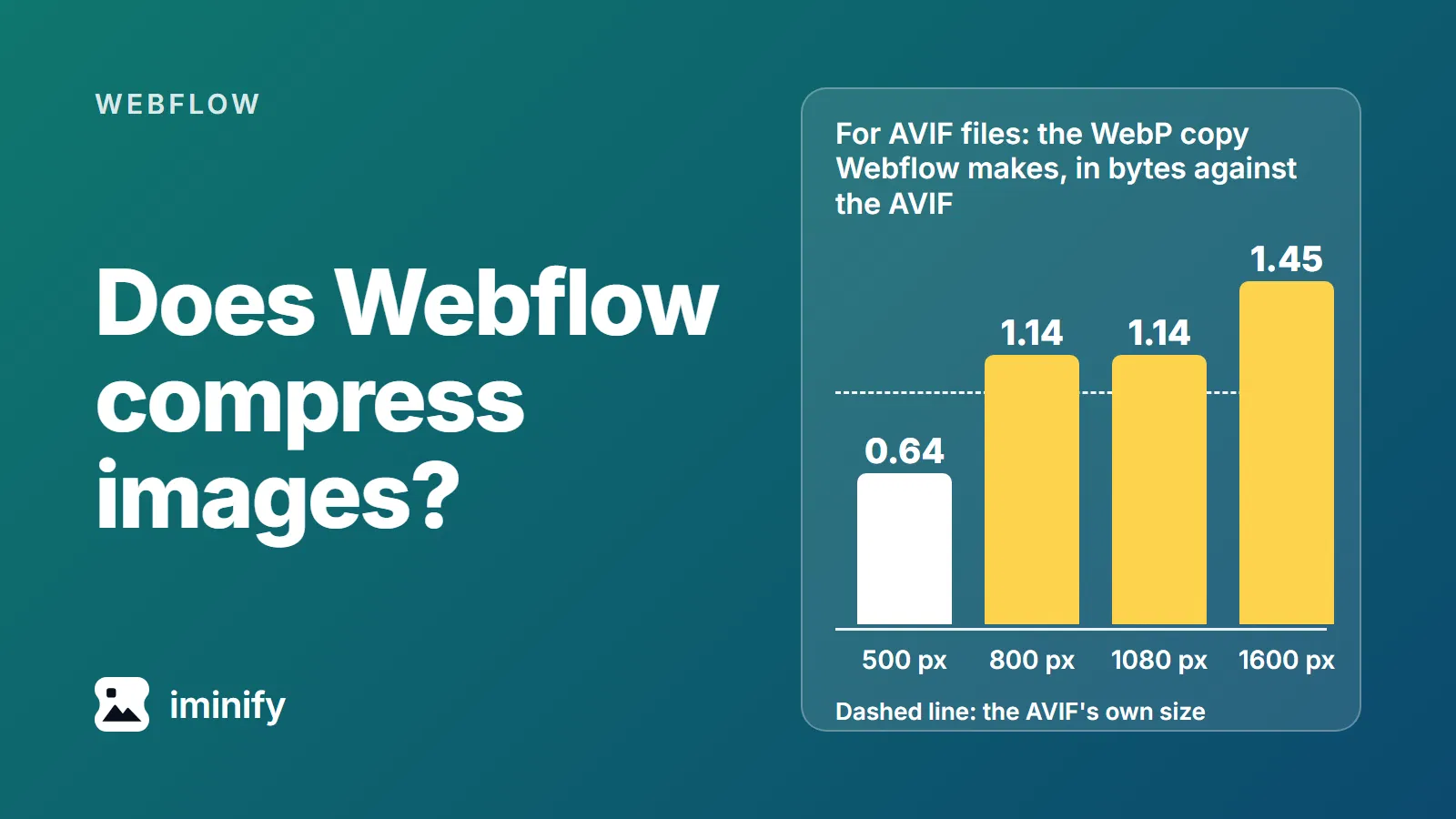
The help lists JPG, PNG and WebP for copies and doesn't name AVIF. Of 172 AVIF files wider than 500 pixels, 114 had copies, and 231 of their 307 copies were WebP. Against the AVIF they came from:
| WebP copy | 500 px | 800 px | 1080 px | 1600 px |
|---|---|---|---|---|
| Median bytes against the AVIF | 0.64 | 1.14 | 1.14 | 1.45 |
| Larger than the AVIF | 20 of 89 | 40 of 72 | 26 of 39 | 12 of 16 |
The table stops at 1600 px: 15 more WebP copies at 2000 px and wider include 11 larger than the AVIF. A srcset gives the browser widths, not file sizes, and the browser picks the first image wide enough for the slot. An extreme case: one 1,920-pixel AVIF of 1,297 bytes had a 1,600-pixel WebP copy of 5,018 bytes.
What to upload to Webflow
- Compress the plain file before you upload, at the size you'll show it. It's what a browser gets whenever no copy applies, and Webflow's help says to compress first. Of the 349 plain JPEGs whose tables match a libjpeg quality exactly, 74 were at 99 or 100. Compress JPEG and Compress PNG keep the format.
- Upload a background image at its display size. It gets no copy.
- If a file on your site is AVIF, check which file the page loads. A page scan collects every image a page loads, each
srcsetsize included. Webflow's help describes a Disable responsiveness checkbox in an image's settings that forces the browser to use the original image size. - Download your originals before using the Compress button. Its help says the original is replaced and can't be converted back.
- Take camera and location data out first. Plain files keep it: of the 2,340 we fetched, 104 carried a camera make or model and 5 carried GPS coordinates. Stripping it with a generic tool can leave a photo sideways, as we measured. Iminify strips both by default, but it keeps your upload until you delete it, and a guest loses access about two hours after the last request while the files stay in storage; its privacy policy says "We keep an upload and its optimized copy until you delete it."
- Mind the 4 MB limit. The help doesn't say whether MB means 1,000,000 or 1,048,576 bytes, and the same question came up for a 5 MB limit. Ten plain files were over 4,000,000 bytes and five over 4 MiB, the largest 8,044,431 bytes. The five are all JPEGs with 2015 asset ids, so they may predate the limit, which we can't check. Iminify's size limit fits an image under a size you set.
How we measured
On 15 November 2026 we drew 400 project addresses with a fixed seed from the 95,152 in Webflow's showcase sitemaps. One page was missing, 19 named no live site and one host repeated, leaving 379 sites: 291 on webflow.io addresses and 88 on custom domains. Chrome 157.0.8103.78 loaded each home page once at 1440 by 900 pixels with the cache off and scrolled to the end; 334 answered 200 and 306 loaded at least one Webflow-hosted image, an address of the form host/<24 hex>/<24 hex>_name.
We fetched each of the 3,771 addresses with Chrome's Accept line and read formats from the file's first bytes. JPEG quality is the libjpeg quality whose luminance table matches.
We read an asset's creation date as the Unix time in the first eight hex digits of its id; the server's Last-Modified was within a day of it for 1,838 of 2,340 plain files. For file names with a space or another encoded character, 44 copies were found only at an address with % written as %25, so those names were tried both ways. All 1,521 copy addresses that pages list in a srcset for the files we probed were found. Pillow 11.1.0 compared the alpha channels. We uploaded nothing to Webflow and didn't run its Compress button.